Choose Dubai if…
UAE
Your clients are spread worldwide or across the Gulf with no Saudi majority; you want a light structure within weeks; your profit will stay modest (0% up to AED 375,000); you bill many consumers, for whom 5% VAT matters.
Both countries let a foreign founder own 100% of a company in most activities, so ownership no longer decides the question. What does: the UAE offers fast incorporation and 9% corporate tax, while Saudi Arabia has a domestic market roughly three times larger by population and reserves most public contracts for groups with a regional headquarters in the Kingdom. Here is the comparison, using official figures.
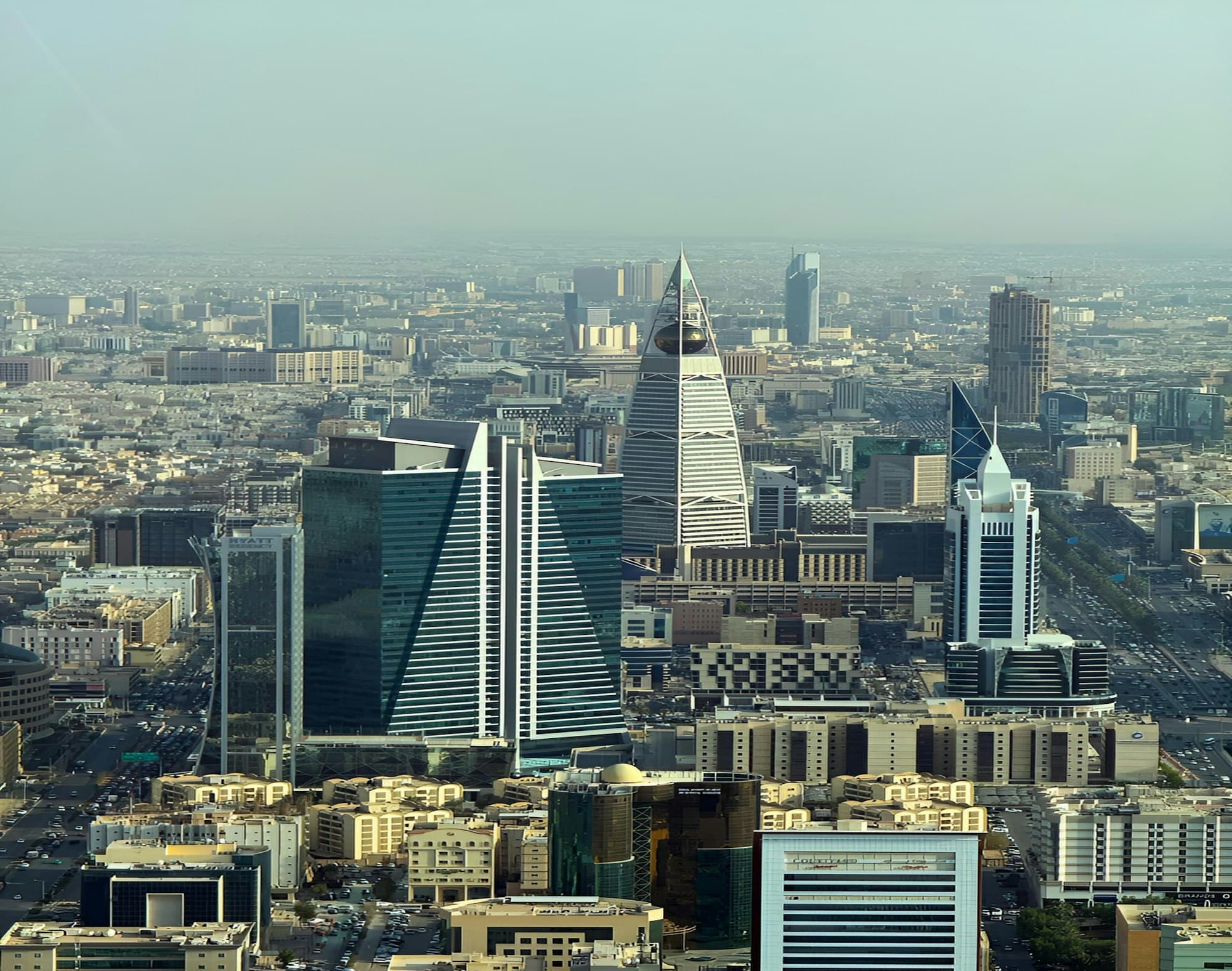
Incorporate where your customers are. If you sell to Saudi companies and government bodies, set up in Saudi Arabia; if you serve international or regional clients from a simple base, Dubai is still quicker to get running.
Ownership has stopped being the deciding factor. UAE Federal Decree-Law No. 26 of 2020 removed the 51% Emirati shareholder requirement on the mainland, and Saudi investment law allows 100% foreign capital in the vast majority of activities. The real gaps are tax, market size, access to public contracts and the duty to hire nationals.
We support company setup in Saudi Arabia. This page is not built to push you there: for several profiles Dubai is the better choice, and we say which ones below.
Values checked against official sources in October 2026 (notes and sources at the foot of the page). UAE costs vary between free zones; DMCC is used as the benchmark because it publishes its prices.
Table 1
| Criterion | Saudi Arabia | UAE (Dubai) |
|---|---|---|
| Foreign ownership | 100% in most activities after MISA registration; excluded activities listed by the ministry | 100% in free zones and, since 2021, on the mainland, except strategic activities (defence, telecoms, banking, insurance…) |
| Incorporation authorities | Ministry of Investment (MISA), then Ministry of Commerce for the commercial registration (CR) | Free zone authority (DMCC, IFZA…) or, on the mainland, the emirate's economy department (Dubai: DET) |
| Government set-up fees | ≈ SAR 1,900 to 2,500 (name, incorporation, publication), plus MISA fees set case by case: 0 to ≈ SAR 62,000 a year, to be confirmed on filing | DMCC: AED 10,345 to 84,515 in initial costs depending on term and office; mainland: depends on activity, to be confirmed |
| Time to incorporate | 4 to 8 weeks to the CR, documents included (practitioner estimate); MISA: 10 working days for a complete file | DMCC: about 10 working days, e-licence 2 to 3 working days after completion |
| Corporate tax | 20% on the share of profit belonging to foreign shareholders; 2.5% zakat on the Saudi or GCC share | 0% up to AED 375,000, 9% above; 0% on qualifying income of an eligible free zone company |
| Withholding tax on dividends paid abroad | 5%, unless a tax treaty gives a lower rate | 0% |
| VAT | 15%; mandatory registration above SAR 375,000 over 12 months | 5%; mandatory registration above AED 375,000 over 12 months |
| Population | 32.2 million (2022 census) | 11.29 million (2024) |
| Public contracts | Regional headquarters (RHQ) in the Kingdom required since 2024, with exceptions including contracts of SAR 1 million or less | No equivalent rule identified for an SME |
| Long-term residence | Premium Residency: SAR 4,000 for the investor or entrepreneur tracks (investor: SAR 7 million invested), SAR 100,000 a year or SAR 800,000 with no business criteria | Golden visa: 10 years (investments) or 5 years (property) from AED 2 million; 5 years for approved entrepreneurs |
| Hiring nationals | Nitaqat: Saudi quota by activity and headcount, one Saudi even for small entities; levy of SAR 700 to 800 a month per foreign employee | Emiratisation: +2% a year in skilled roles from 50 employees; 20 to 49 employees in 14 sectors: one Emirati in 2024, one more in 2025 |
| What year one costs | ≈ SAR 33,000 to 59,000 for a services LLC in Riyadh, excluding MISA fees and salary (illustrative example) | AED 35,000 to 50,000 with a flexi-desk at DMCC, excluding visas (DMCC figures) |
Yes, in both, for most activities. In the UAE, Federal Decree-Law No. 26 of 2020 took effect in early 2021 and was later consolidated into Decree-Law No. 32 of 2021; it opened the mainland to 100% foreign ownership, leaving only activities of strategic impact, such as defence, telecoms, banking and insurance, under specific rules.
In Saudi Arabia, the foreign investor first registers with MISA, which has issued an investment registration certificate since the revised Investment Law came into force in February 2025. The company is then incorporated with the Ministry of Commerce, usually as an LLC or a branch.
Structure choice matters more in the UAE. A free zone company is quick to form and has its own tax regime, but it is designed to operate from the zone or abroad; selling directly into the UAE market usually means a mainland licence or a distributor. Saudi Arabia has no such split for an SME: one route, MISA and then the commercial registration.
Saudi government set-up fees are low, but MISA fees and the cost of employing the manager weigh afterwards. In Dubai, the free zone licence carries most of the spend. Public amounts checked in October 2026.
Table 2
| Item | Saudi Arabia | Dubai (DMCC free zone) |
|---|---|---|
| Initial registration | MISA fees set case by case on approval: 0 to ≈ SAR 62,000 a year according to advisory firms, to be confirmed on filing | Application AED 1,035, registration AED 9,020, articles of association AED 2,020 |
| Incorporation and trade name | LLC incorporation SAR 1,200 + publication SAR 500 + VAT (≈ SAR 1,955 incl. VAT); name SAR 200 (Arabic) or SAR 500 (foreign language) | Included above |
| Annual licence | Annual CR confirmation: SAR 1,200 a year for an LLC, from year two | Licence AED 20,285 a year; establishment card AED 1,825 a year |
| Packages | No public package | From AED 10,345 (lightest offer) to AED 35,484 (Basic Biz, one year) and up |
| Office | Business centre in Riyadh: ≈ SAR 12,000 to 25,000 a year (illustrative example) | Flexi-desk or office: AED 15,000 to 20,000 a year (DMCC figures) |
UAE corporate tax is 0% on taxable income up to AED 375,000 and 9% above, for financial years starting on or after 1 June 2023. A free zone company that meets the Qualifying Free Zone Person conditions pays 0% on its qualifying income; this is not automatic, and its other income is taxed at 9%.
In Saudi Arabia, the share of profit belonging to foreign shareholders is taxed at 20% and filed with ZATCA (the Zakat, Tax and Customs Authority). The share held by Saudi or GCC nationals pays 2.5% zakat on a separate base. Dividends paid abroad bear 5% withholding tax unless a treaty lowers it; the UAE rate is 0%.
Saudi VAT is 15%, against 5% in the UAE. The mandatory registration threshold is 375,000 over 12 months in both countries, in SAR and AED respectively. For a B2B service provider, VAT passes to the client; it bites mainly on sales to consumers.
Local tax is only half the calculation. Your personal tax residence and where the company is effectively managed decide what you finally pay, so check the rules of your home country before choosing on tax rates alone.
Saudi Arabia counted 32.2 million residents at the 2022 census, 18.8 million of them Saudi nationals. The UAE had 11.29 million in 2024 according to its federal statistics centre. The Saudi domestic market is roughly three times larger by population.
Since early 2024, Saudi ministries, authorities and public funds no longer sign contracts with a foreign company whose regional headquarters is outside the Kingdom, with exceptions including contracts of SAR 1 million or less. The rule targets multinational groups: running Saudi public clients from Dubai no longer works above that threshold.
An SME does not need a regional headquarters to start. But if your clients are ministries, sovereign funds or the Kingdom's large projects, a registered Saudi company becomes the entry ticket rather than an option. Capital-specific points are covered in setting up a company in Riyadh.
The UAE golden visa is a 5- or 10-year residence with no sponsor: 10 years for an investment of at least AED 2 million, 5 years for property of the same value, and 5 years for entrepreneurs whose project is backed by an incubator or a relevant authority in the emirate.
Saudi Premium Residency plays a similar role. Its investor and entrepreneur tracks cost SAR 4,000 in fees; the investor track requires SAR 7 million invested in a MISA-registered company and 10 employees. Without business criteria it costs SAR 100,000 a year, or SAR 800,000 for an unlimited term. Most SME founders use the manager's iqama of their own company instead.
Both countries require you to hire nationals, under different rules. In Saudi Arabia, Nitaqat sets a Saudi ratio by activity and headcount, with one Saudi employee even for small entities, and each foreign employee carries a levy of SAR 700 to 800 a month: see Saudization and Nitaqat.
In the UAE, Emiratisation targets mainland companies with 50 or more employees: +2% Emiratis a year in skilled roles, 10% by 2026, and a contribution of AED 6,000 a month per missing Emirati in 2023, rising by AED 1,000 a year. Since 2024, companies with 20 to 49 employees in 14 sectors must also employ one Emirati, then a second by the end of 2025.
Neither country is better in absolute terms. These are the profiles for which each choice holds up.
UAE
Your clients are spread worldwide or across the Gulf with no Saudi majority; you want a light structure within weeks; your profit will stay modest (0% up to AED 375,000); you bill many consumers, for whom 5% VAT matters.
Saudi Arabia
Your clients are Saudi companies, government bodies or projects; you target public procurement; you need a local presence to hire, deliver or get vendor-registered; you accept 4 to 8 weeks of setup and Nitaqat duties in exchange for a market three times larger by population.
Dual setup
A Dubai company can be the shareholder of a Saudi LLC: MISA accepts a foreign company as investor, with its certified corporate documents and accounts. Many groups keep Dubai for the region and open a Saudi subsidiary once Saudi revenue justifies it.
Disclosure
Tasis Partners supports company setup in Saudi Arabia, not in the UAE. If your project clearly belongs in Dubai, we will tell you on the first call rather than steer you towards Riyadh.
It depends on your clients. Dubai suits a regional or international business that wants a fast structure and 9% corporate tax above AED 375,000 of profit. Saudi Arabia is the better fit if your clients are Saudi, especially public bodies, since government contracts have required a regional headquarters in the Kingdom since 2024, with exceptions.
UAE corporate tax is 0% up to AED 375,000 of taxable income and 9% above, for financial years starting from 1 June 2023; a qualifying free zone company pays 0% on qualifying income. In Saudi Arabia, the foreign share of profit is taxed at 20% and the Saudi or GCC share pays 2.5% zakat.
For private clients, occasional sales from Dubai remain possible, with Saudi withholding tax on some service payments made to non-residents. For government entities, the regional headquarters rule applied since 2024 excludes companies without a headquarters in the Kingdom, with exceptions including contracts of SAR 1 million or less.
The DMCC free zone quotes AED 10,345 to 84,515 in initial costs and AED 35,000 to 50,000 for the first year with a flexi-desk. In Saudi Arabia, government set-up fees are about SAR 1,900 to 2,500, but the first year of a services LLC costs roughly SAR 33,000 to 59,000 in our illustrative example, before MISA fees set case by case.
Yes. The UAE mainland has been open to 100% foreign ownership since 2021, except for strategic activities, and free zones already were. In Saudi Arabia, a foreigner can own 100% of a company in the vast majority of activities after registering with the Ministry of Investment (MISA).
The UAE golden visa requires AED 2 million in investments or property, or an entrepreneurial project backed by an incubator. Saudi Premium Residency costs SAR 4,000 for the investor or entrepreneur tracks, but the investor track requires SAR 7 million invested and 10 employees. For an SME founder in Saudi Arabia, the manager's iqama through their own company is the usual route.
Yes. A UAE company can be the sole shareholder of a Saudi LLC; MISA then asks for its certified corporate documents, as for any foreign company. This setup is common among groups that serve the region from Dubai and open a subsidiary when their Saudi business grows.
Information verified in October 2026. Amounts and timelines are observed ranges provided for information only. Government fees are set by Saudi authorities and may change: they are confirmed in writing in the quote before you commit to anything.
Tell us who your clients are, where they are and what you expect to bill in year one. We reply in writing on whether a Saudi company makes sense, including when Dubai looks like the better fit. If Saudi Arabia is the answer, we scope your project and coordinate its delivery with licensed professionals in Riyadh. First call free, written reply within one working day.